Why Does My House Smell Musty? (And How to Find the Source)
A musty smell in the house has six common causes, from a dry P-trap to mold in the HVAC. Walk through them in order, smell strongest first, and you can usually find the source in an afternoon.

Quick answer: A musty house smell almost always traces to moisture somewhere it shouldn’t be. The six common causes, ranked by how often I see them: a dry P-trap in a rarely-used bathroom letting sewer gas through, mold or mildew behind drywall from a small leak, biofilm on the HVAC evaporator coil or condensate pan, damp basement or crawlspace, water-damaged carpet or upholstery, and roof or attic moisture. Find the room where the smell is strongest, then narrow down from there.
A house that smells musty is telling you about moisture, and moisture is what kills home values, ruins drywall, and breeds mold. Musty smells almost always have a specific source you can find in an afternoon if you work through the house systematically. Most homeowners try to mask the smell with candles or plug-ins first, which means the underlying problem keeps growing while the symptom hides.
There are six common causes. They show up in roughly this order across the homes I’ve worked on, and each one has a specific tell. Work through them by following the smell to the strongest source first, then matching what you find to the cause below.
Step 1: Walk the House and Find Where the Smell Is Strongest
Before anything else, get specific about where it stinks. Smells get attributed to “the whole house” when really they’re coming from one source and drifting through ductwork or hallways.
- Open every interior door so air can move between rooms.
- Walk the house slowly, room by room, including closets, the basement, and the laundry area.
- Note which room hits hardest. Get your nose down low, near the floor, and up high near the ceiling. Musty smells often pool in one of those two zones.
- Check the supply vents on the HVAC. Hold a hand near each one and smell. If the smell is coming out of the vents themselves, the issue is in the system, not the room.
Once you know the room, match it to one of the six causes below.
Cause 1: A Dry P-Trap in a Rarely-Used Bathroom
This is the cause I see most often, and it’s the easiest to miss because nothing looks wrong.
Every sink, shower, and floor drain in the house has a P-trap underneath, the U-shaped pipe that holds a small puddle of water. That puddle is the seal that blocks sewer gas from drifting up out of the pipe and into the room. If a bathroom or laundry sink hasn’t been used in a few weeks, the water in the trap evaporates, and sewer gas walks straight through. The smell is musty, sour, sometimes faintly like rotten egg.
Diagnose: Run water at every fixture in the room for 30 seconds. If the smell fades over the next few hours, the P-trap was your problem. Floor drains in basements and laundry rooms are the most common offenders because they go months without use. (For a smell that reads more like sewage than musty, our house smells like sewer diagnostic also covers wax ring and vent stack causes.)
Fix: Once a month, run every fixture in the house for 30 seconds. Pour a cup of water plus a tablespoon of mineral oil down floor drains that are rarely used, the oil floats on the water and slows evaporation. For a sewer smell after replacing a sink, the trap may have been installed wrong, check it before doing anything else.
Cause 2: Mold or Mildew Behind Drywall (From a Small Leak)
If the smell is strongest near a specific wall, especially below a window, near a bathroom or kitchen plumbing wall, or in the corner of a basement, you may have water in the wall cavity. Even a slow leak that puts out a few drops a day will grow mold on the back of the drywall paper within a couple of weeks. The mold itself doesn’t always show up on the visible side, but the smell makes it through.
Diagnose:
- Press lightly on the suspect wall. Soft, spongy, or stained drywall is a strong sign.
- Look for a stain along the baseboard or near the ceiling, often a faint brown ring.
- Check the wall behind the toilet, the wall behind the dishwasher, the wall under any window, and any spot near a roof valley above.
Fix: You need to find and fix the leak first, then cut out the affected drywall. If you skip the leak-find step and just patch over the wet drywall, the mold and smell come right back. Small water-damaged sections of drywall are a DIY patch job once the source is dry. Anything bigger than about 2 feet square, especially if you can see black or green mold, gets a mold remediation pro. The cost difference between a $200 wall patch and a $5,000 remediation is whether you caught it early.
Cause 3: Mold or Biofilm on the HVAC Evaporator Coil
If the musty smell hits every time the AC kicks on, and gets faint or disappears when the AC is off, the source is inside the air handler. The evaporator coil and condensate pan inside the indoor unit run wet all summer, and biofilm (a slimy mix of dust, mold, and bacteria) builds up on the coil fins. The blower then pushes air across that biofilm and into every room of the house. People describe it as “dirty sock smell” because that’s exactly what the bacterial film smells like.
Diagnose: Turn the thermostat to fan-only and run the system. If the smell appears, it’s the air handler. If it doesn’t, the smell is in a room and the AC was just spreading it.
Fix:
- Replace the air filter if you haven’t recently. A clogged filter is part of why the coil stays wet too long.
- Flush the condensate drain with a cup of distilled white vinegar (see why your AC float switch keeps tripping for the full procedure, biofilm in the drain line is the same problem).
- For the coil itself, a no-rinse foaming coil cleaner sprayed on the indoor coil during the off-season is the right home-DIY step. Heavy buildup gets a yearly HVAC service.
- UV lights installed in the air handler kill biofilm before it grows back. They run about $200-400 installed and the bulb gets replaced once a year. For homes that get this smell every summer, the UV light pays for itself in not needing a coil cleaning service.
Cause 4: Damp Basement or Crawlspace
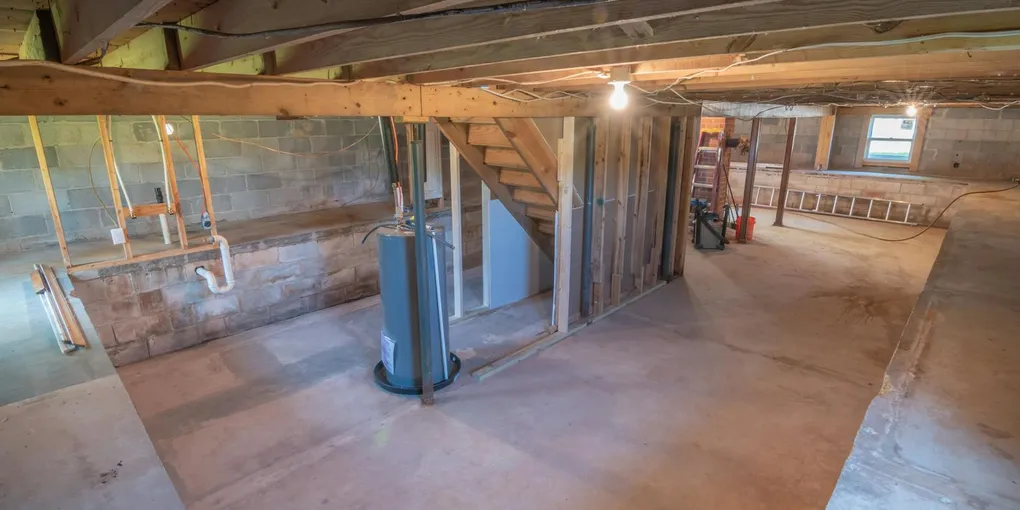
If the smell follows you down the stairs or comes up through floor vents in the basement, the basement itself is the source. Concrete walls are porous. They wick moisture from the soil outside, and on a humid day that moisture evaporates into the basement air. Combined with even a tiny amount of organic material (a cardboard box, an old rug, drywall), you get the textbook basement smell.
Diagnose:
- Look for white powdery deposits on the basement walls. That’s efflorescence, the mineral residue that water leaves behind when it evaporates through concrete. It means water is moving through that wall.
- Check the humidity with a $15 hygrometer. Basement humidity above 60% breeds mold growth on anything organic.
- Look for rust on basement metal, that’s a sign of long-term high humidity.
Fix:
- Run a dehumidifier sized for the basement square footage. Aim for 45-50% relative humidity. A 50-pint unit ($200-300) handles most basements. Empty the tank daily or run a drain hose into a floor drain.
- Address any obvious water entry, exterior drainage problems, downspouts dumping next to the foundation, cracks in concrete walls (which can be sealed with hydraulic cement).
- Get the cardboard, fabric, and other organic stuff off the floor. Plastic bins on shelves, not cardboard on concrete.
Cause 5: Water-Damaged Carpet or Upholstery
If the smell is strongest at floor level and concentrated in one room, the carpet may be holding old moisture. A spilled drink, a pet accident, or a small plumbing leak that soaked the carpet and dried slowly can leave bacteria and mold in the carpet padding even after the surface looks fine. Upholstered furniture does the same thing.
Diagnose: Get on your hands and knees and smell the carpet directly. Compare different spots in the room. The wet spot has a distinct musty-sour smell vs. fresh carpet, which smells like dust.
Fix: If it’s a small spot, a deep carpet cleaning with an enzymatic cleaner ($20 a bottle from a pet store) followed by full drying with a fan can save it. If the smell is in the padding, the carpet has to come up and the padding has to be replaced. For furniture, professional upholstery cleaning works on cushions; antique upholstery may need to be discarded.
Cause 6: Roof Leak or Attic Moisture
If the smell is strongest near a ceiling or in an upstairs bedroom, water may be getting into the attic. A failed roof flashing, an ice dam from last winter, or poor attic ventilation can keep moisture in the insulation, where it grows mold on the joists and on the back of the drywall ceiling.
Diagnose:
- Look at the ceiling for stains or sagging, even small ones.
- Go into the attic with a flashlight. Look at the insulation, is it damp? Look at the underside of the roof decking, is it stained, soft, or showing dark patches?
- Check the soffit vents and ridge vent. Attics need cross-ventilation to dry out; blocked vents trap moisture year-round.
Fix: Roof leaks get a roofer. This isn’t a DIY repair on anything beyond a single missing shingle, because if you misdiagnose the source you’ll keep getting water for years while thinking you fixed it. Attic ventilation upgrades (adding ridge vents, clearing soffit vent blockage) are doable for a confident DIYer.
Common Mistakes to Avoid
Masking the smell with candles, plug-ins, or sprays. Air freshener doesn’t fix the underlying moisture. The smell becomes “perfume plus mold” and the source keeps growing.
Assuming any musty smell is mold. Some of the smells in this list (the dry P-trap, the dirty-sock HVAC) are bacterial, not mold. Bleach-bombing every surface won’t help.
Ignoring it because guests don’t notice. Nose-blind is real. If you’ve smelled your own house long enough, your brain has stopped registering the smell. Ask someone who doesn’t live there.
Skipping the leak hunt and just patching. Cutting out moldy drywall and putting up new drywall without finding the water source is buying yourself a six-month delay before the smell comes back.
Buying a $400 air purifier first. Air purifiers help with allergens and particulates, but they don’t fix the source of musty smells. Find the cause first. The same logic applies to a house that gets dusty fast, the cause is usually upstream of the visible dust (duct leaks, low-grade filter, attic-hatch air leak), and a purifier alone won’t fix it.
Frequently Asked Questions
My house only smells musty when it rains. What’s that mean? Almost always a crawlspace or basement humidity issue. Rain raises outdoor humidity, the moisture works through foundation walls, and the smell rises into the living space. A dehumidifier in the lower level is usually the fix. (If the smell is specifically rotten eggs rather than musty, that’s hydrogen sulfide from the water heater or a possible gas leak, different diagnostic entirely.)
The smell is worst in the morning. Why? Overnight the house is closed up and HVAC running creates the strongest air circulation. If the source is in the air handler or basement, that’s when it concentrates. Run the bathroom fan when you shower and the kitchen fan when you cook to push moisture out.
Can I just shock the house with bleach to kill the smell? No. Bleach kills surface mold but doesn’t penetrate porous materials like drywall or wood, and it doesn’t address the underlying moisture. Without finding and fixing the source, the smell returns.
My HVAC professional says the coil is clean but the smell is still there. Now what? Check the condensate drain and pan first; biofilm grows in the pan even when the coil looks clean. Also check the air filter slot for any kind of debris, sometimes the issue is a filter that was too thin or installed backwards and let dust onto the coil.
Is a musty smell dangerous? The smell itself isn’t dangerous, but the moisture causing it usually is, long-term. Mold spores can affect respiratory health, especially for kids, older adults, and anyone with asthma. The faster you find the source, the smaller the eventual repair.
Can a washing machine cause a musty smell in the house? Yes, and front-load washers are the most common culprit. The rubber door gasket, the accordion-style seal around the opening, traps moisture between uses and grows mold if the door stays closed. The smell starts in the laundry room and spreads from there. Wipe the gasket with a white vinegar solution after each load and leave the door cracked open when the machine is idle. Running an affresh washing machine cleaner tablet ($6-8 for a 3-pack, most grocery stores carry it) once a month keeps the drum and gasket clean. For top-loaders, the smell usually traces to the detergent drawer or a mildew line around the inner drum rim. Whirlpool and LG both flag gasket cleaning as a routine maintenance step in their front-load care documentation, and it’s the one most people skip.
Walk the rooms, smell the vents, check the P-traps in the unused bathrooms first because that one fix is free. After that, the suspects are wet drywall, the HVAC, the basement, the carpet, or the attic. Trust the room where the smell is strongest. Find the source, fix the moisture. The smell goes with it.