Why Is My AC Not Turning On (5 Things to Check Before Calling a Pro)
AC won't start at all is a power problem, not a refrigerant problem. Four free things to check before calling an HVAC tech. Two of them solve it most of the time.

Quick answer: An AC that won’t turn on at all is a power problem, not a refrigerant problem. Check four things in order. First, the thermostat is set to “cool” and has fresh batteries. Second, the AC breaker at the main panel isn’t tripped. Third, the outdoor disconnect box next to the condenser is engaged. Fourth, the float switch on the indoor air handler isn’t tripped from a clogged drain. If all four are good and the AC still won’t start, the start capacitor on the outdoor unit has failed (a $20 part) but the compartment stores dangerous voltage, so this is the point to call an HVAC tech.
There’s a useful split when an AC isn’t cooling: it either won’t turn on at all (no outdoor fan, no indoor blower, nothing) or it turns on but blows warm air. The first is electrical. The second is refrigerant, airflow, or compressor. They have completely different fixes, and the first is the one you can usually solve yourself for free.
This article is about the first case, AC that won’t start. If your AC is running but not cooling, see our AC not blowing cold air guide instead.
Most “AC won’t turn on” calls to HVAC techs end up being one of four things, all of which a homeowner can diagnose and fix without tools (the broader HVAC troubleshooting guide covers running-but-not-cooling cases too). The technician shows up, flips a breaker, charges $125 minimum service call, and leaves. Save the $125. The diagnostic order below is what every HVAC tech checks first anyway.
Power Problem vs. Refrigerant Problem
A quick test before you start. With the AC set to cool and the temperature set lower than the room temperature, listen:
- Silence everywhere (no indoor blower, no outdoor fan): power problem, this guide.
- Indoor blower runs but no outdoor fan: partial power problem (Steps 3-5 below, especially the disconnect and the capacitor).
- Both run but air at the vents is warm: different problem entirely, see the AC not blowing cold guide linked above.
- Outdoor unit runs in short bursts then shuts off: capacitor failure, Step 5.
If you got “silence everywhere” or “indoor blower only,” continue.
What You’ll Need
- A flashlight or headlamp
- Fresh AA or AAA batteries (whatever your thermostat uses)
- A small Phillips screwdriver
- Optional: a non-contact voltage tester ($15) for checking the disconnect
- Optional: a wet/dry vacuum for the float-switch step
No tools you’d need to buy. The whole diagnostic takes 15 minutes.
Step 1: Check the Thermostat
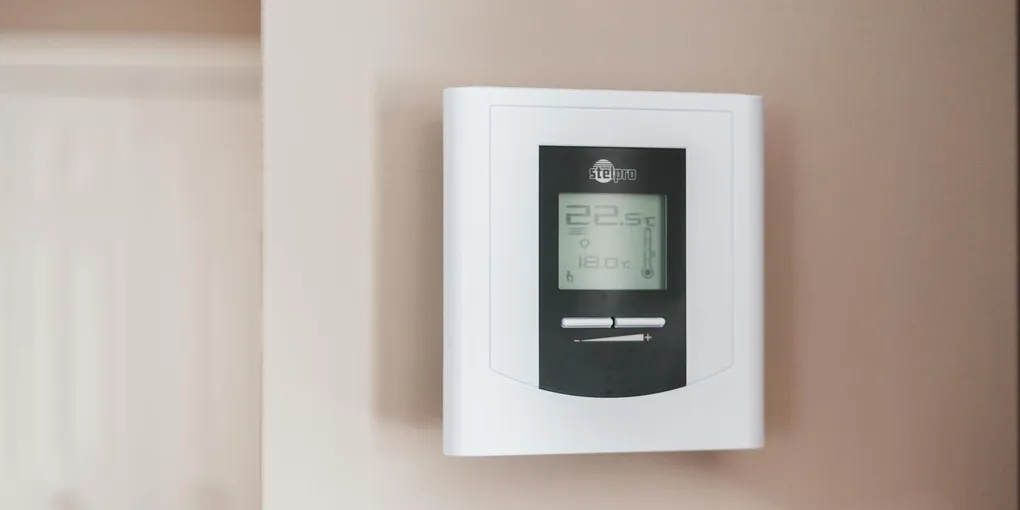
Walk to the thermostat. Three things to confirm:
- Mode is set to “Cool” (not Off, not Heat, not Fan). Sounds basic, gets missed every spring when people switch over.
- Setpoint is lower than current room temperature. The thermostat does nothing if the room is already cooler than what it’s asked to maintain. Try setting it 5 degrees below the current room temp.
- Display is on and shows a normal reading. A blank screen means dead batteries. A weak screen means low batteries (replace anyway, batteries are $2).
Pull the thermostat off the wall (most snap off the base plate with a gentle tug) and replace the batteries even if the display looks fine. In older mechanical-display thermostats, dead batteries are what trip people up most often, they stop calling for cooling without any warning indicator. Snap it back on, wait 30 seconds for the system to re-handshake, and try again.
If you have a smart thermostat (Nest, Ecobee, Honeywell Lyric), confirm:
- It’s connected to wifi (a thermostat that loses its connection sometimes also loses cooling commands)
- It’s not in “vacation mode” or “eco mode” that holds temperature higher than you’d expect
- The schedule isn’t set to “Off” for the current hour
Step 2: Check the AC Breaker at the Main Panel
The AC has its own circuit breaker at the main electrical panel, usually a 30-50 amp double-pole breaker labeled “AC,” “A/C,” “condenser,” or “HVAC.”
- Open the main panel.
- Find the AC breaker. Double-pole means two switches tied together by a small bar.
- Look at the position. A tripped breaker sits in the middle (between On and Off) and may look “on” at a glance.
- To reset, push the breaker firmly to Off (you’ll feel a click), then back to On.
- Walk outside to the AC unit. The fan should start within 1-2 minutes if the thermostat is calling for cooling.
Breakers trip from one of three things: a brief power surge (one-time, won’t recur), a failing AC component drawing too much current (it’ll trip again within minutes), or age (breakers themselves wear out after 30+ years).
If the breaker trips again within a few minutes of resetting, stop resetting. Repeatedly resetting a tripping breaker is what causes electrical fires. Call an HVAC tech, the unit is drawing too much current and something downstream has failed.
Step 3: Check the Outdoor Disconnect Box
Right next to the outdoor AC unit (the condenser) is a small gray metal box mounted on the wall. That’s the disconnect, a code-required local kill switch separate from the main panel breaker.
- Open the disconnect box. Inside is one of three things: a pull-out fuse block, a lever switch, or a fuse and switch combination.
- Confirm the pull-out is fully seated (push it in firmly), or the switch is flipped to “On.”
- If there are visible fuses (cartridge-style or screw-in), look for a blown fuse (a melted or discolored center). Replace if needed, fuses run $5 a pair, available at any hardware store, marked with the amperage you need (matches the breaker rating).
The disconnect is the most-missed step for homeowners diagnosing their own AC. It gets pulled for service and not put back. It gets kicked by a weed trimmer. It gets bumped by a delivery truck. Always check.
Use a non-contact voltage tester if you have one. Hold it near the wires inside the disconnect (don’t touch the wires), it should beep or light up. If it doesn’t, no power is reaching the disconnect, which points back to the main panel breaker (Step 2).
Step 4: Check the Float Switch on the Indoor Air Handler
The indoor unit (the air handler, usually in an attic, closet, basement, or crawl space) has a drain pan that catches condensation from the cooling coil. A small float switch sits in or near that pan. When water rises above a certain level (because the condensate drain line is clogged), the float trips and cuts power to the entire AC system as a safety measure. Otherwise the pan overflows and floods the ceiling below.
A tripped float switch is the most common “AC won’t turn on” cause in summer.
- Find the air handler.
- Locate the drain pan, usually under the indoor coil or under the whole unit.
- Is there water in the pan? Yes, the condensate line is clogged. Vacuum the water out, then clear the drain line per our float switch guide.
- The float switch should reset automatically once the water is below its threshold.
- If the pan is dry but the AC still won’t start, the switch may have failed in the “tripped” position. Replace it ($10-20 part).
A clogged condensate line accounts for more summer AC service calls than any other single failure, EnergyStar’s maintenance guidance lists it as the most common preventable AC failure, and a once-a-year cleanout prevents it. Pairing the drain cleanout with a fresh HVAC filter is good practice: a heavily clogged filter slows airflow through the indoor coil, which increases condensate production and puts more load on the drain line.
Step 5: When It’s the Capacitor (Call a Pro)
If all four checks above are good and the AC still won’t start, the most likely failure is the start capacitor in the outdoor unit. Symptoms:
- A humming or buzzing sound from the outdoor unit with no fan movement
- The outdoor fan starts only if you spin its blades by hand with a stick (do NOT do this except as a diagnostic, and only with power cut)
- The unit starts but cycles off within seconds
- A visible bulged or leaking capacitor inside the outdoor unit (don’t open the cover, just noting the symptom)
The capacitor is a $20-40 part. The job takes 20 minutes for a tech. The issue is that the outdoor unit’s electrical compartment contains a capacitor that stores 250-440 volts of dangerous charge even after power is cut. HVAC techs use a tool that safely discharges it. Homeowners without that tool can get a serious shock that has killed people.
This is the line where the DIY guide stops. Pay the $125-200 service call. The tech will discharge the capacitor, swap it, test the system, and be on their way in 30 minutes.
Common Mistakes to Avoid
Resetting a breaker that keeps tripping. A breaker tripping is the safety system catching a real problem. Repeatedly resetting it overheats wires and can cause a fire. One reset is fine, repeated trips means stop and call a tech.
Opening the outdoor unit’s electrical compartment. The capacitor stores dangerous voltage long after power is cut. Don’t open the cover unless you have the discharge tool and know how to use it.
Pouring water down the condensate drain to “clear it.” Water doesn’t clear an algae or sludge clog. A wet/dry vacuum at the drain’s outdoor exit pulls the clog out from the bottom. (See the float-switch article linked above for the procedure.)
Assuming “no cooling” means refrigerant. A refrigerant leak is the most expensive AC diagnosis ($500-2,000 in repairs). Don’t go there before ruling out the four free fixes above. Most “no cooling” calls aren’t refrigerant.
Skipping the thermostat batteries. Smart thermostats often have a low-battery indicator. Older mechanical ones don’t, they just stop calling for cooling silently. Replace batteries every year as a maintenance habit.
Frequently Asked Questions
My AC was working yesterday and won’t start today. What changed? Something tripped overnight. Most likely a breaker (power surge during a storm), a float switch (condensate buildup from a heavy-use day), or a thermostat battery that finally died. Run through Steps 1-4. One of them is the answer.
The outdoor fan runs but the indoor unit doesn’t. Is this the same problem? Different problem, the outdoor unit is healthy. The indoor blower has its own power supply (sometimes a separate breaker), and the blower motor or its capacitor has failed. The thermostat may also have a wiring problem that calls for cooling but not for the fan. Worth an HVAC visit.
My AC starts, runs 30 seconds, then shuts off. Repeats forever. Power problem? This is short-cycling, often caused by a failing capacitor (Step 5) or a refrigerant issue. Either way, time to call a tech. Don’t let it short-cycle for days, the compressor isn’t built to take it and a $20 capacitor failure can escalate to a $1,500 compressor replacement.
How much does an HVAC service call usually cost? $100-200 in most markets for a diagnostic visit, plus parts. Capacitor swap typically runs $150-300 total. Bigger jobs (compressor, refrigerant recharge, coil replacement) cost more.
Is it worth getting an annual AC tune-up? For a unit older than 5 years, yes. A $100-150 tune-up catches a failing capacitor, a clogged condensate line, a dirty coil, and low refrigerant before any of them turn into a no-cooling emergency in July. The Department of Energy estimates tune-ups can recover 5-15% of cooling efficiency, paying back the cost in 1-2 summers.
What if I have a heat pump instead of a traditional AC? Run the same diagnostic: thermostat settings, main breaker, outdoor disconnect, float switch. Two extra things to check first. Confirm the thermostat isn’t set to “Emergency Heat.” Emergency heat mode bypasses the outdoor unit entirely and runs only the electric resistance strips in the air handler, which produce heat rather than cooling. Most thermostats label it “Em Heat” and show an orange or red indicator light when it’s engaged. Second, heat pumps stop cooling efficiently when outdoor temperatures drop below about 40°F, but that’s normal physics, not a failure. If both those check out and the heat pump still won’t start, the capacitor and contactor diagnostics in Step 5 apply the same way as a standard AC.
Run the four steps in order, batteries, breaker, disconnect, float switch, before you reach for the phone. Two of those four solve most cases. The fifth step is where the tech earns the service fee, and the capacitor isn’t a part to swap without training.