Why Is My AC Not Blowing Cold Air? (8 Causes & Fixes)
AC blowing warm or room-temp air? The 8 most common causes, most fixable yourself in under an hour, and the 2 that need a pro.

Quick answer: If your AC is not blowing cold air, work through eight causes in order. Start with the air filter, a clogged filter is the cause 40% of the time. Confirm the thermostat is set to COOL with fan on AUTO. Check the indoor unit for ice (frozen evaporator coil, turn off, thaw 1-3 hours, replace filter). Check outdoor condenser coils for debris, verify the breaker and outdoor disconnect, and clear the condensate drain. Refrigerant or compressor issues need an HVAC pro.
When your AC is running but the air coming out is warm or barely cool, something specific is wrong, it’s not just “running poorly.” There are 8 common causes, and most are fixes you can do yourself in under an hour. Two require an HVAC pro and shouldn’t be DIY’d (the full diagnostic flow across every cooling and heating issue is in our HVAC troubleshooting guide).
Our system died on a 96-degree day last August because I’d let the filter go four months past the calendar reminder. The evaporator coil froze solid. I had to shut the whole thing off and let it thaw for about three hours before the AC would even run again, then change the filter and pray. It came back. The lesson cost me one miserable afternoon and a phone call to my brother apologizing for cancelling a thing I’d promised to come help him with. Don’t skip the filter.
Safety: Working on AC components involves electrical and (occasionally) refrigerant. Diagnostic steps below are safe; if any step requires opening the inside of the outdoor unit or handling refrigerant, stop and call a pro.
The 8 Causes (Ranked by Frequency)
- Dirty air filter (40% of cases)
- Thermostat set wrong
- Frozen evaporator coil (no airflow, ice on indoor unit)
- Dirty outdoor condenser coils
- Tripped breaker or disconnect
- Clogged condensate drain
- Low refrigerant (pro needed)
- Failed compressor or capacitor (pro needed)
Let’s work through each.
Cause 1: Dirty Air Filter
By far the most common cause, and the easiest fix.
A clogged filter restricts airflow across the indoor evaporator coil. Less airflow = less heat removed from the air = warm air out the vents. In severe cases, restricted airflow causes the coil to freeze (Cause 3).
Diagnostic: When did you last change the filter? More than 3 months ago = likely culprit.
Fix:
- Locate your filter, usually in the return-air vent (large grille on wall or ceiling), or in a slot at the front of the indoor unit.
- Slide the old filter out. Hold it up to a light, if you can’t see light through it, it’s clogged.
- Note the size printed on the frame (e.g., “20x25x1”).
- Buy a replacement. MERV 8-11 is the right range for most homes (higher MERV = better filtration but more airflow restriction).
- Slide the new filter in, paying attention to the airflow arrow (must point toward the unit).
- Run the AC. Within 30 minutes you should feel cold air.
Set a phone reminder to change the filter every 2-3 months going forward.
Cause 2: Thermostat Set Wrong
Embarrassing but extremely common.
Diagnostic:
- Is the thermostat set to COOL, not “fan only” or “heat”?
- Is the temperature setting below the current room temperature?
- Is the fan set to AUTO, not “ON”? “ON” runs the fan continuously, which feels like room-temp air during the AC’s compressor off-cycles.
Fix: Adjust accordingly. If the thermostat seems unresponsive (display blank, buttons not working), replace the batteries, most thermostats use 2 AA batteries behind the faceplate.
Cause 3: Frozen Evaporator Coil
If you have warm air AND ice or frost visible on the indoor unit or copper lines running to it, the evaporator coil is frozen.
Causes of freezing:
- Dirty air filter (back to Cause 1)
- Closed or blocked vents
- Low refrigerant (Cause 7)
- Failing blower fan
Fix:
- Turn the AC OFF immediately. Running it with a frozen coil damages the compressor.
- Switch the fan to “ON” at the thermostat, this thaws the coil faster.
- Wait 1-3 hours for full thaw. Have towels ready for the melt water.
- Once fully thawed, replace the filter and turn the AC back on with the fan set to AUTO.
- If it freezes again within a day, refrigerant is likely low → call a pro.
Cause 4: Dirty Outdoor Condenser Coils
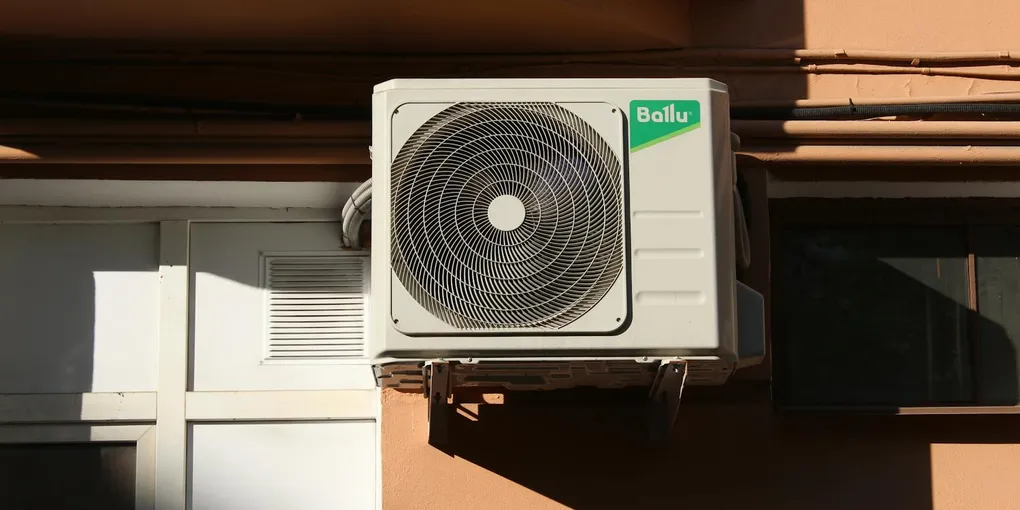
The outdoor unit (condenser) releases heat from inside your home to outside air. If the fins are coated in cottonwood fluff, grass clippings, dust, or grime, it can’t release heat efficiently, and the air conditioning effect drops.
Diagnostic: Walk outside and look at the outdoor unit. The fin coils on the sides should look reasonably clean. Heavy gray fuzz or matted debris = dirty.
Fix: See how to clean AC condenser coils for the full method. Quick version:
- Shut off power to the outdoor unit at the disconnect (the box on the wall next to it) AND at the breaker.
- Gently brush debris off the fins.
- Spray gently with a garden hose from inside the unit outward (not blasting from outside in).
- Let dry, restore power.
Do this annually in spring before AC season.
Cause 5: Tripped Breaker or Disconnect
The AC system has two breakers/switches:
- Inside the house at the main breaker panel
- A “disconnect” box on the wall next to the outdoor unit
If either is off, the outdoor unit doesn’t run, and you’ll feel weak room-temperature air from the vents (just the indoor fan blowing without cooling).
Diagnostic:
- Listen at the outdoor unit. Is it running (fan spinning, hum)? If not, power is off. (For the case where the AC won’t start at all and nothing is running, see our AC won’t turn on diagnostic.)
- Check the breaker panel for a tripped AC breaker.
- Check the outdoor disconnect, flip the switch off, then back on.
Fix: Reset the breaker / disconnect. If it trips again, you have an electrical fault, call a pro.
Cause 6: Clogged Condensate Drain
The AC removes humidity from the air, which drains out via a small PVC pipe. If that drain clogs (algae, debris), some systems shut down the cooling cycle as a safety measure.
Diagnostic: Look for water around the indoor unit or in the drain pan beneath it.
Fix:
- Find the drain pipe (usually a 3/4” PVC pipe near the indoor unit, ending outside).
- Use a wet/dry vacuum on the outdoor end of the pipe, suction out the clog.
- Alternative: pour 1 cup of distilled white vinegar into the access port (a T-shaped fitting on the pipe near the indoor unit) every 3 months as preventive maintenance.
Cause 7: Low Refrigerant (Pro Needed)
Refrigerant is the chemical that absorbs heat inside and releases it outside. If your system is low, cooling capacity drops. Refrigerant doesn’t get “used up”, if you’re low, you have a leak.
Diagnostic:
- Coil keeps freezing even with clean filter and clean coils
- Hissing sound near the indoor unit or outdoor lines
- Oil staining at copper line connections (refrigerant carries oil)
Fix: Call an HVAC pro. Handling refrigerant requires EPA certification, the right gauges, and leak detection. DIY refrigerant kits sold at auto parts stores are not legal for home AC use and don’t address the underlying leak.
Cause 8: Failed Compressor or Capacitor (Pro Needed)
The compressor is the heart of the outdoor unit. The capacitor is a part that gives it a starting kick. Either failing means no cooling.
Diagnostic:
- Outdoor unit hums but the fan doesn’t spin = bad fan capacitor (cheap fix for a pro)
- Outdoor unit clicks but won’t start = bad start capacitor or run capacitor
- Outdoor unit completely silent (and breaker is on) = could be compressor or contactor
Fix: Capacitors are technically DIY-replaceable but they store dangerous voltage even when power is off. Compressor failure usually means a major repair or system replacement. Both are pro territory.
Quick Diagnostic Flowchart
AC running but warm air?
├── Check filter → dirty? Replace. Done (40% of cases).
├── Filter is clean. Check thermostat settings.
├── Settings correct. Look for ice on indoor unit.
│   ├── Yes ice → turn off, thaw, replace filter.
│   └── No ice → continue.
├── Check outdoor unit. Is it running?
│   ├── No → check breaker + disconnect.
│   └── Yes → check if coils are dirty.
└── All above OK and still warm → call HVAC pro.
Common Mistakes to Avoid
Running an AC with a frozen coil. Damages the compressor. Turn it off the moment you see ice.
Cranking the thermostat down to 60°F to “cool faster.” Doesn’t work, your AC runs at one speed. It just runs longer. Set it to your actual target temperature.
Skipping filter changes. A $20/year habit prevents 80% of AC problems.
Closing vents to “force more air to other rooms.” Backpressures the system and reduces efficiency. Vents should mostly stay open.
Trying to DIY refrigerant. Illegal, ineffective, and the underlying leak won’t be fixed.
Frequently Asked Questions
How long should AC take to cool a hot house? A properly sized AC drops the indoor temperature about 1°F per hour on hot days. From 85° to 75° = roughly 10 hours of continuous running. Not 30 minutes.
Why does my AC freeze in summer but work in spring? As outside temperatures rise, your AC works harder. Marginal problems (slightly low refrigerant, slightly dirty coils) cause freezing only under high load.
Is it cheaper to repair or replace an old AC? Rough rule: if the repair cost exceeds 50% of replacement cost AND the system is 10+ years old, replace. New high-efficiency systems pay back the difference within 5-7 years.
What temperature should I set my AC to? For energy efficiency: 78°F when home, 85°F when away. For comfort: most people prefer 72-74°F. Each degree lower = ~3% more energy use.
Should I cover my AC in winter? A small breathable cover over the top is fine. A full plastic cover traps moisture and causes corrosion. Many techs say no cover at all is better.
My window AC is running but not cooling. Same checklist? Mostly. Window units share the dirty-filter and frozen-coil causes with central AC. Check the filter first; window unit filters are small foam pads that clog faster than pleated central-air filters. They’re washable: rinse under the faucet, let dry fully, reinstall. Look for frost visible through the front louvers; if you see any, the coil is frozen. Turn the unit off for an hour, then restart with a clean filter. What window units don’t have: a condensate drain line you can service, an outdoor disconnect to check, or refrigerant you can legally handle yourself. If a window unit blows warm air with a clean filter and no ice, the compressor or run capacitor has failed. Units under five years old with a bad capacitor can sometimes be repaired economically by an appliance tech; older than that, a new 10,000-BTU window unit runs $150-250 and replacement usually pencils out better than repair.
An AC not blowing cold air is usually a 10-minute fix, change the filter, check the thermostat, look for ice. Work through the list systematically. The early causes (filter, thermostat) solve 60% of problems on their own. By the time you’re checking outdoor coils and considering a refrigerant call, you’ve already eliminated the easy wins. Stay ahead by changing filters quarterly and cleaning the outdoor coils every spring.