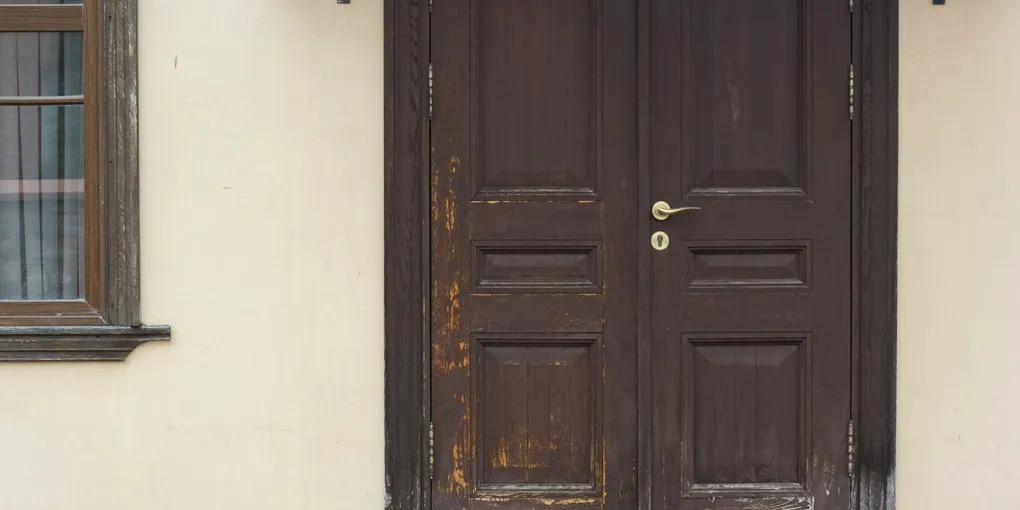
How to Repair a Rotten Exterior Door Frame (Without Replacing the Whole Door)
Soft, spongy wood at the bottom of an exterior door frame is wet rot. Small patches fix with two-part epoxy. Larger sections get a Dutchman. Here is how to decide which.

Quick answer: Spongy, soft wood at the bottom of an exterior door frame is wet rot caused by water sitting against the wood. Probe with a screwdriver to map how far the rot goes. Patches under about 6 inches can be cut out and filled with two-part epoxy (Abatron WoodEpox, PC-Petrifier as the primer). Patches 6 inches to 2 feet get a Dutchman, a cut-in patch of new wood scarfed into the jamb. Anything beyond 2 feet means replacing the jamb leg or sill, half-day finish-carpentry work. Find the water source first or the rot comes right back.
The most common spot for exterior door rot is the bottom 8 inches of the hinge-side jamb leg. The reason is geometry: rain hits the door, runs down, lands on the sill, and the corner where the jamb meets the sill is where water pools. Add a worn weatherstrip, a cracked caulk joint at the trim, or a sprinkler hitting the door every day, and within five or six years that corner is a sponge.
Most people don’t notice until they go to paint and the paint won’t take, or the storm door pushes a screw through the soft wood, or they step on the threshold and feel it move. At the early stage the fix is an afternoon with epoxy. If the rot has traveled up the jamb, you’re adding a circular saw and a half-day of finish carpentry to the project.
How to Tell What You’re Dealing With
Push the tip of a flathead screwdriver into the wood at the suspect spot. Press firmly, not violently.
- Tip goes in less than 1/8 inch: Wood is firm. Surface paint failure only. Sand, prime, repaint.
- Tip sinks 1/4 to 1/2 inch and lifts out a fiber chunk: Early rot. Epoxy fix below.
- Tip sinks more than 1/2 inch easily, the wood is wet and dark: Active rot. Epoxy works only if the patch is small. Dutchman or jamb replacement if it’s wider than a quarter dollar.
- Tip pushes through the whole jamb thickness: Structural rot. The jamb leg has to come out.
Probe at 2-inch intervals up the jamb until you hit firm wood again. Mark the firm spot with a pencil. The rotted area is what you’re dealing with, plus 2 inches of “still soft enough to be in trouble” wood above the firm line. Plan to remove or treat that extra 2 inches too.
Find the Water Source First
Skipping this step is how you do the repair twice. Three places to check:
- The threshold caulk joint. Run a finger along the seam where the threshold meets the door frame on each end. A cracked or missing bead of caulk lets water under the threshold and into the bottom of the jamb. Replace the caulk with a polyurethane sealant (Sika 1A or Vulkem 116, both 25-year products) before the repair.
- The trim caulk joint. Run a finger along where the exterior trim meets the siding. Same crack, same fix.
- The sprinkler or splash zone. Stand outside, look at the door. Is a downspout dumping water onto the threshold? Does a sprinkler head hit the lower 8 inches every morning? Is the door at the bottom of a slope where rainwater runs toward it? Fix the source before the wood goes in.
Pro consensus from the Builder’s Association of Greater Indianapolis (a good plain-language source) lists 80 percent of exterior door rot tracing to either bad caulking or splash exposure. Fix the source, then fix the wood.
What You’ll Need
For an epoxy fix (small rot, under 6 inches):
- Five-in-one painter’s tool or a chisel
- Drill with a 1/4-inch bit
- Wood-hardener primer (PC-Petrifier or Minwax High Performance Wood Hardener, $15)
- Two-part epoxy wood filler (Abatron WoodEpox or Bondo Wood Filler, $25 to $35)
- Putty knife
- 80- and 120-grit sandpaper
- Exterior primer and matching trim paint
For a Dutchman (medium rot, 6 inches to 2 feet):
- Oscillating multi-tool with a wood blade
- Speed square
- A piece of clear, pressure-treated or cedar 5/4 stock that matches the jamb thickness
- Construction adhesive (PL Premium or Loctite PL)
- Exterior trim screws or finish nails
- Caulk and paint
For a full jamb replacement (large rot, over 2 feet): beyond DIY for most people. Call a finish carpenter or replace the pre-hung door.
Step 1: Cut Out the Rot
Don’t try to fill rotten wood. Soft wood and epoxy don’t bond properly, water keeps wicking through, and the repair fails inside a year.
With a chisel or the painter’s tool, remove every soft fiber you can dig out. Keep going until you’re hitting firm wood on all sides of the cavity. Vacuum the chips out.
For an epoxy fix, the cavity can have an irregular shape. Don’t square it off.
For a Dutchman, square the cavity with the oscillating multi-tool. A clean rectangle is much easier to patch than a triangle. Make the cut at least 1 inch into firm wood on all four sides.
Step 2: Drill Drain Channels (Epoxy Method Only)
This step gets skipped most often and is the reason most epoxy repairs fail.
Drill a series of 1/4-inch holes 1 inch deep into the firm wood at the bottom of the cavity, angled slightly outward. Six to eight holes for a small patch. These give the wood hardener and the epoxy a mechanical key to grip, and they let any future water trapped behind the patch escape rather than build up.
If you skip these, the epoxy bonds only to the cavity surface, and the first hard rain peels it back off.
Step 3: Treat the Cavity With Wood Hardener
PC-Petrifier and Minwax Wood Hardener are thin epoxy resins that soak into the surrounding wood and chemically convert soft cellulose fibers back into something hard. Both are inexpensive ($15) and both work, neither is a substitute for cutting out the soft stuff but they harden the boundary.
Brush or pour the hardener generously into the cavity. Cover all the wood surfaces, especially the drilled holes. Let it cure 4 hours before the next step.
Step 4: Fill With Two-Part Epoxy
Abatron WoodEpox and Bondo Wood Filler are both two-part epoxy fillers. Mix the parts on a piece of cardboard in roughly equal volumes, the consistency should be like soft modeling clay.
Press the mixed filler into the cavity, overfilling slightly so it stands proud of the surface. Smooth with a putty knife, working it into the corners.
Cure time depends on temperature. Above 70 degrees, you’re sanding in 2 to 4 hours. Below 50 degrees, plan for next-day work.
Step 5: Sand, Prime, Paint
Once cured, the epoxy sands like wood. Start with 80-grit to knock down the high spots, then 120 to feather it into the surrounding jamb. Aim for a surface flush with the original wood.
Prime the entire repaired area, the bare epoxy, and 4 inches of surrounding paint, with an exterior bonding primer (Zinsser Cover Stain or Kilz Premium). Two coats of exterior trim paint on top. The repair is invisible once painted.
The Dutchman Method (For Larger Patches)
For rot from 6 inches to about 2 feet, the cleaner repair is to cut out the rotted section and let in a new piece of wood. Carpenters call this a Dutchman.
- Square the cavity with the oscillating tool. Make all four cuts at right angles. The depth should match the depth of the rot, usually the full jamb thickness or close to it.
- Cut a replacement piece from clear pressure-treated, cedar, or PVC trim stock 1/16 inch smaller than the cavity in both dimensions. This gives you room to caulk the seam.
- Run a heavy bead of construction adhesive on all contact surfaces. Press the patch in. Drive 2-inch exterior trim screws through pre-drilled pilot holes into the surrounding firm wood, two screws minimum.
- Caulk the seam with a paintable exterior sealant.
- Sand, prime, paint as in Steps 5 above.
The Dutchman is a stronger long-term repair than epoxy for larger patches because you’re putting wood-against-wood with mechanical fasteners and a flexible sealant joint, instead of expecting epoxy to span a wide area.
When the Whole Jamb Has to Go
If the rot extends more than 2 feet up, or runs across the threshold and into the opposite jamb leg, you’ve got a full jamb replacement on your hands. This is a different scope: the door has to come off, the trim has to come off, the brick mold or exterior casing has to be carefully removed, and the new jamb has to be installed plumb, square, and shimmed before the door goes back on.
That’s finish-carpentry work and takes a half day for someone who’s done it before, all day for a first-timer. A finish carpenter charges $300 to $600 for the job, plus the cost of a replacement jamb leg ($40 to $80) or a pre-hung door ($300 to $700 if the door itself is also bad).
If you’re considering replacing the door anyway because it’s old, this is the moment to bundle the work. Replacing a whole pre-hung exterior door (the door, jamb, threshold, and brick mold as one unit) is actually easier than a custom jamb-leg repair on an old frame.
Common Mistakes to Avoid
Painting over rotten wood. Hides the problem for a season, then the paint blisters as the rot continues underneath. Always cut out the soft material first, even on a small patch.
Using regular wood filler instead of two-part epoxy. Wood fillers like DAP Plastic Wood are for interior trim repairs, not for exterior wet zones. They absorb water, fall apart in freeze-thaw cycles, and don’t bond to wet wood. Two-part epoxy is the right product for exterior rot, and the price difference is $10.
Skipping the wood hardener. People look at the cavity, see firm-ish wood at the edges, and think the hardener is optional. The wood at the edges of the rot is the next layer to fail. Hardener locks it down for years.
Not finding the water source. The repair is the easy part. If the threshold caulk is gone or the gutter dumps water on the doorway, the repair fails. Spend 15 minutes finding the leak before you mix epoxy.
Doing the repair in cold weather. Two-part epoxies need 50 degrees or warmer to cure properly. Below that, the chemistry slows down and the bond is weak. May through October is the season for this work in most climates.
FAQ
How long does an epoxy door frame repair last? A correctly-done epoxy patch (firm wood underneath, hardener applied, drain holes drilled, two-part filler) lasts 15 to 20 years if the water source has been addressed. Skip any of those steps and you’re looking at a 1- to 3-year fix.
Can I do this repair in the winter? Two-part epoxies need at least 50 degrees Fahrenheit during application and the first 24 hours of cure. Most epoxy fixes wait until spring or fall. If you must do it in winter, a portable heater pointed at the work area for 24 hours after application can work, but it’s awkward and the result is mixed.
Is there a difference between Abatron and Bondo wood filler? Yes. Abatron WoodEpox is a true wood-like filler that takes screws and nails after curing and sands smoothly. Bondo Wood Filler is auto-body-style filler relabeled, it’s cheaper ($15 vs. $35), sets faster, and works fine for small patches but doesn’t hold fasteners as well. Use Abatron for anything you’d want to drive a hinge screw into; Bondo for cosmetic surface patches.
My door frame is rotted from the inside, behind the trim. How do I know how bad it is? Carefully pry off the interior or exterior casing trim with a flat bar. If the rot is hidden inside the wall cavity behind the jamb, you’re looking at a full jamb replacement no matter how big the visible damage is. Hidden rot is also a signal to check the subfloor under the threshold, water that rotted the jamb has been running down to the floor for years.
Can I just replace the bottom 6 inches of the jamb leg without taking the whole door off? Yes, this is the Dutchman approach above, scaled up. Cut the jamb leg horizontally at a clean point above the rot, splice in a new bottom section of jamb stock, and finish the seam. Tricky but possible. Easier with the door off, but doable with it on if you support the door on a sawhorse during the work.
Will replacing the threshold prevent this from happening again? A new threshold and weatherstrip is part of the prevention package. Aluminum thresholds with adjustable inserts (Pemko, Frost King brand sweeps) seal much better than 20-year-old wood thresholds with worn rubber. Pair the threshold replacement with fresh polyurethane caulk at the jamb-sill corners and you’ve solved the source of 80 percent of repeat rot.
Can I use PVC trim board instead of wood for the Dutchman patch? Yes, and in an exterior wet zone it’s often the smarter material. Cellular PVC trim (Azek, Versatex, and Kleer are the common brands) doesn’t absorb water and won’t rot, so you’re not setting up the same repair in 15 years. It takes exterior paint the same way wood does. The one tradeoff: PVC doesn’t hold screws as well as wood grain does, so use PVC-specific fasteners (Cortex FastenerMate screws or similar) and apply a heavy bead of PL Premium construction adhesive on all contact faces. Cut it with a standard circular saw or miter saw, same as wood. For any Dutchman going into a spot that’s been wet repeatedly, PVC gives you a one-time fix instead of a recurring maintenance item.
Probe before you patch. Find the water source before you mix epoxy. The right answer for a small patch is two parts in a tub and a putty knife; the right answer for a large patch is a multi-tool and a piece of clear cedar; and the right answer for a whole-jamb situation is to budget the morning and either learn finish carpentry or hire it out. For an inspection-time guide on the door’s hardware side, our door that won’t close properly walkthrough covers the latch and strike alignment, and once the frame is solid, replacing the worn-out weatherstripping along the jamb is the second half of keeping the water out next time.