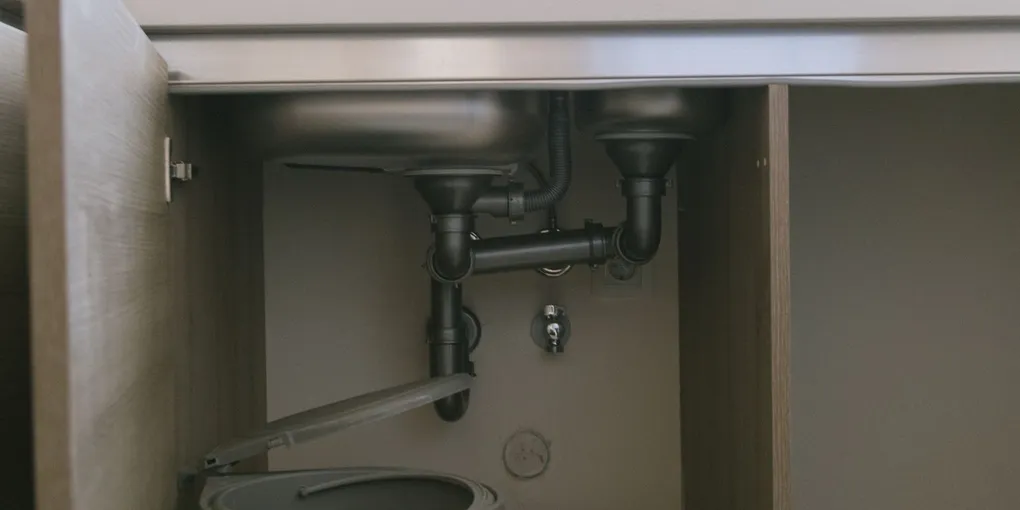
How to Fix a Garbage Disposal Leaking From the Bottom (Honest Answer: You Don't)
Water dripping from the bottom of a garbage disposal means the internal motor seal has failed. The unit is dead. Here is how to confirm it and what to replace it with.

Quick answer: Water leaking from the actual bottom of a garbage disposal (not from a side connection) means the internal motor seal has failed. The unit is finished. Garbage disposal motors are sealed for life at the factory; once water reaches the motor, the windings short and the bearings rust. No homeowner repair brings it back. The fix is replacement. A Badger 5 (1/2 HP, the workhorse) runs $90 to $120 at Home Depot, and the swap takes 30 to 45 minutes if the existing mount stays. Don”t waste a weekend trying to caulk or reseal the bottom, it won”t hold.
This is the article I wish someone had written for me before I spent two hours under a sink with a tube of silicone trying to “fix” a leak that wasn’t fixable. Disposal manufacturers don’t make the internal seals user-serviceable for a specific reason: the motor sits in a sealed housing with grease bearings that are good for 8 to 12 years of normal use, and once water gets past the shaft seal, the metal corrodes fast.
The five-minute version of this article: if water is dripping from the very bottom of the disposal (the center, where there are no pipes or rings), the seal is gone. Replace the unit. The rest of this article covers how to confirm it’s actually a bottom leak (vs. a fixable side leak), what to buy, and the swap procedure.
First Confirm It’s a Bottom Leak
Disposals have four places they leak from, and three of the four are repairable. The bottom is the one that isn’t.
Stand a folded paper towel under the disposal and watch what gets wet:
- Center bottom of the unit (the round metal “puck” with no pipes): Motor seal failure. Replace.
- Top of the disposal where it bolts to the sink drain (the mounting flange): Plumber’s putty has dried out. Reseal the flange, $5 and an hour.
- Side outlet where the disposal connects to the drainpipe: Rubber gasket on the discharge tube. Replace the gasket and re-tighten the screw, $3 part.
- Dishwasher inlet (the smaller side connector): Loose hose clamp. Tighten the clamp.
Run water through the disposal for 30 seconds, watch the paper towel, and read where the wet spot starts. The center-bottom leak is what this article addresses. For the other three, the fixes are quick and the unit doesn’t need replacement.
Why a Bottom Leak Means Replacement
The motor housing on a residential garbage disposal is a die-cast aluminum or steel can that holds the motor, the bearings, and the grinding chamber’s underside. A shaft seal separates the wet side (grinding chamber) from the dry side (motor). When that seal fails:
- Water seeps past the shaft into the motor housing.
- Water hits the motor windings, which are not sealed against water.
- Water reaches the bearings, which are packed grease, not running in oil.
Once any of this happens, the motor starts failing. Even if the disposal still runs today, the bearings rust, the windings short, and within weeks to months the unit stops entirely or trips the breaker repeatedly.
Manufacturers don’t sell shaft seal kits because:
- Disassembling the disposal requires a press to remove the motor flywheel.
- Reassembly requires re-balancing the rotating mass to within manufacturer spec, the same way an HVAC tech balances a fan blade.
- A new $90 Badger 5 is cheaper than buying the tools and parts for the rebuild even if the parts existed.
Insinkerator’s published service guidance (from their warranty support team’s training documents, widely cited on /r/Plumbing) explicitly says shaft seal leaks are non-repairable.
What to Replace It With
Three popular options, in order of price:
Insinkerator Badger 5, 1/2 HP, $90 to $120. The workhorse. Handles a normal household’s food waste. Quiet enough. Lasts 8 to 12 years on average. This is the right answer for 90 percent of homes.
Insinkerator Badger 500, 1/2 HP, $130 to $160. Same horsepower, slightly upgraded grind chamber and quieter operation. Worth the extra $30 if you live with the disposal noise daily.
Moen GX Series GX50C, 1/2 HP, $110 to $140. The main competitor to Insinkerator. Slightly different mounting system (Moen QuickConnect vs. Insinkerator Twist Mount). If you’re already on Insinkerator’s mount, stay with Insinkerator, the new unit drops onto the existing mount in 5 minutes instead of replacing the whole assembly.
Bigger HP options (3/4 HP, 1 HP) exist but are overkill for a normal kitchen. A 1/2 HP unit handles potato peels, apple cores, citrus rinds, and rice without issue. You only need 3/4 HP+ if you’re running heavy food prep daily (large family, lots of cooking from scratch) or grinding bones, which most manufacturers don’t recommend anyway.
What You’ll Need
- Replacement disposal (matching brand to keep the existing mount if possible)
- A bucket and old towels
- A flathead screwdriver
- A Phillips screwdriver
- Channel-lock pliers
- A non-contact voltage tester (or just confirm the breaker is off)
- Plumber’s putty (only if you’re replacing the mounting flange)
- Optional: a disposal wrench (the small Allen-style tool that ships with new units)
About an hour of work for a first-time swap, 30 minutes if you’ve done it before.
Step 1: Cut Power
The disposal has its own switch (usually on the wall above the counter) and its own circuit breaker. Turn off both.
Test with a non-contact voltage tester at the switch and at the disposal cord. The tester should not beep. If you don’t have a tester, flip the switch on and off after killing the breaker; if the disposal doesn’t even click, power is off.
Step 2: Disconnect the Plumbing
Bucket under the disposal.
- Loosen the slip nut on the discharge tube (the pipe leaving the side of the disposal). Channel-locks if it’s tight. Water comes out, ready the bucket.
- If the dishwasher drains into the disposal, loosen the hose clamp on the small dishwasher inlet and pull the hose off.
- Disconnect the discharge tube fully and set it aside.
The disposal is now hanging from its sink-flange mount with no plumbing connections.
Step 3: Drop the Disposal Off the Mount
Insinkerator units use a Twist Mount: turn the lower mounting ring counter-clockwise (looking up from below), about a quarter-turn. The disposal drops into your hands. They’re heavier than they look, support the unit before turning.
Moen and other brands use a similar twist-off or a slip-collar mechanism, same general procedure.
Step 4: Unwire the Old Unit
On the underside of the disposal is a small electrical access cover (usually one screw). Remove it.
Inside you’ll find three wires: black (hot), white (neutral), and green or bare copper (ground). Photograph the connections before you disconnect, useful reference for reconnection.
Unscrew the wire nuts, separate the wires, remove the cable clamp, and pull the cord out of the old disposal. The cord usually transfers to the new unit unless you’re changing brands.
Step 5: Wire the New Unit
Same procedure in reverse. The new unit comes with its own wiring port and usually a small plate. Match the wires: black to black, white to white, green to green or bare copper. Wire nuts on each connection, then tug each nut to confirm the connection is tight.
Reinstall the access cover.
Step 6: Test the New Disposal Mount
If you’re staying with the same brand, the existing mounting ring on the sink works with the new unit. Test fit by lifting the new disposal up and rotating it onto the mount. It should click into place.
If you’re changing brands (Insinkerator to Moen or vice versa), you need to replace the sink flange and mounting assembly. That’s a different procedure, adds about 30 minutes, and requires fresh plumber’s putty under the new sink flange. Most people stay with the existing mount to avoid this.
Step 7: Reconnect the Plumbing
- Slip nut on the discharge tube, hand-tight plus a quarter-turn.
- Dishwasher hose back onto the inlet, hose clamp tight.
- Confirm the disposal is rotated so the discharge points toward your drainpipe.
Step 8: Power Up and Test
- Turn the breaker back on.
- Run water in the sink.
- Flip the disposal switch. It should run smoothly with no rattle.
- Check every joint you touched for leaks. Watch for 60 seconds. Tighten any drip.
Done. The new unit lasts 8 to 12 years.
Common Mistakes to Avoid
Trying to caulk or epoxy the bottom of an old disposal. Silicone, JB Weld, plumber’s epoxy, none of them bond to greasy aluminum on a vibrating motor housing. The fix lasts a day, maybe a week. Spend the hour on a real replacement instead.
Buying a bigger HP “upgrade” when you don’t need it. A 1 HP disposal is heavier, louder, and three times the price of a 1/2 HP unit. Unless you’re running a small restaurant out of your kitchen, the Badger 5 is enough.
Forgetting to reset the overload breaker on the new unit. Most disposals have a red reset button on the underside. If the unit hums but doesn’t spin on first test, press the reset.
Skipping the dry fit before final wiring. Hold the new disposal up to the mount before wiring it. Confirm the discharge will line up with your drainpipe at one of the mounting positions. Some mounts only have one orientation, and if your drain piping doesn’t quite reach, you’ll know now instead of after wiring.
Putting food down the new disposal in the first hour. Run cold water through it for a full minute after install, with no food, to flush metal shavings from the manufacturing process. The first real meal happens after that flush.
FAQ
My disposal is leaking from the side, not the bottom. Can I fix that? Yes. Side leaks at the discharge tube are a $3 rubber gasket and a screwdriver. Side leaks at the dishwasher inlet are a $1 hose clamp. The top leak (where the disposal meets the sink) is plumber’s putty drying out, $5 and an hour to redo. Only bottom (center) leaks are non-repairable.
Can I run the dishwasher into a new disposal that doesn’t have a dishwasher inlet? All major-brand new disposals have a dishwasher inlet, but the inlet is plugged from the factory. You have to knock out the plug with a hammer and a flathead screwdriver before connecting the dishwasher hose. If you don’t, the dishwasher backs water up into itself and floods. This is the number one new-disposal install mistake.
How long does a garbage disposal last on average? Insinkerator and Moen both rate their entry-level units (Badger 5, GX50C) for 8 to 12 years of normal residential use, and that matches what licensed plumbers report. Cheaper builder-grade units (the kind installed in new construction to save $20) often die at 5 to 7 years. Hard water and high mineral content shorten lifespan by 2 to 3 years.
Why does my disposal hum but not spin? Different problem, the motor is fine but the grinding chamber is jammed. See our garbage disposal that hums guide for that one, it’s a 5-minute fix with a hex key.
Is it worth replacing a disposal under warranty? If your disposal is under 5 years old and started leaking, check the warranty paperwork. Insinkerator’s Badger series has a 2-year warranty; their Evolution series has 4 to 10 years. Moen’s GX series has 5 years. The warranty covers the unit but rarely the labor. If it’s under warranty, file the claim, you’ll save the cost of the new unit.
Can I install a disposal myself if I’ve never done plumbing or electrical? Yes, if you’re comfortable with both at a basic level. The plumbing connections are slip nuts and hose clamps, no soldering or pipe cutting. The electrical is three wires under a single cover plate. The Department of Energy estimates 70 percent of disposal swaps are DIY. If you’ve replaced a light fixture and a P-trap, you can do this.
My new disposal drains slowly right after installation. What should I check? Two things. First, confirm the discharge tube runs downward from the disposal to the P-trap, not level or slightly uphill. A flat run holds water in the tube and slows drainage noticeably. The tube should drop at least 1/4 inch per foot from the disposal outlet to the P-trap. Second, check whether the dishwasher knockout plug was removed. New disposals ship with a plastic plug inside the dishwasher inlet; if you connected a dishwasher hose without knocking it out, the dishwasher water backs up into the disposal instead of draining, which slows or stops flow in both directions. Knock it out from inside the grinding chamber with a flathead and a hammer, retrieve the plastic disc, and test again. For persistent slow drainage after those two checks, see our kitchen sink unclogging guide for the P-trap and trap arm inspection.
A center-bottom leak on a garbage disposal is a death sentence for the unit, not a project for a weekend. The $90 replacement and an hour of straightforward work get you back to a working sink and a fresh 10-year lifespan. The other three leak types are quick fixes, just verify which one you actually have before you spend the money. For diagnosing a disposal that’s making noise without spinning (a separate and much cheaper fix), our garbage disposal hums walkthrough has you covered.